

Photo by M. Shawn Crahan (link to source appears above). Click for larger view.
Shawn Crahan, the drummer from the band Slipknot who usually goes by Clown, turns out to have been an unlikely Polaroid maniac. From 1999 to 2009, he shot thousands of instant photos, and he’s got a new book of them called The Apocalyptic Nightmare Journey. And I’ll tell you, I wasn’t expecting much when I heard about this book—you never know with people’s side projects, and the title’s a little overcooked—but they’re good! He does heavy modification of the image and manipulation of the emulsion, in ways I can’t figure out. Interview plus slideshow here, on RollingStone.com. Clown knows his stuff.
 Love this, from Petapixel. Full instructions provided. (The photo doesn’t actually pop out of the slot as you open the card, but maybe you paper-engineering types can work that out on your own.)
Polaroid’s early instant films were pretty slow in speed, rated at ASA 100. They were also “orthochromatic,” meaning they responded to some wavelengths of light more strongly than others. (Practically speaking, that meant that red and yellow objects registered as nearly black, and only the green/blue/violet range registered as you’d expect.)
In 1955, that changed with the introduction of two new products: Type 42 and Type 44. They were panchromatic films, meaning they responded to all visible wavelengths. Type 42 was rated at ASA 200; Type 44, at ASA 400. Here’s a brick of three rolls of Type 44, still sealed in the factory cellophane.


The red-on-gray-with-white-logos packaging was on its way out in favor of Paul Giambarba’s black-end-panel designs.
“Use before May 1962.” Most likely produced, therefore, in early 1961. (Ask not what your camera can do for you.) This product stayed in the line until ’63, by which time I suspect the much faster Type 47 had gobbled up its sales. That may be why the packaging hadn’t been updated to match the others; why bother for a product that’s on its way out?

You were instructed to flatten the box and use it as a little photo wallet.
Polaroid film that’s 50 years old is almost sure to be unusable, because the pod dries out. I do wonder whether the extra layer of protection provided by the plastic wrap just might have kept this stuff active. (Probably not. I’m loath to break the seal, anyway. It’s a museum piece, like this one.) Couple of good-looking examples of Type 44 here, on Giambarba’s blog.
The 20×24 Polaroid cameras have photographed three presidents and a scattering of vice-presidents and first and second ladies, and a few days ago Chuck Close added another to the credits list: Barack Obama sat down before the lens, at the Jefferson Hotel in Washington. Close plans to use them (as he often does) as source material for a painting and a tapestry portrait.

The president poses.

Obama and Close review the day’s take.

End-of-the-day celebration by the team.

Scrutinizing the work, as it’s set up on the copy stand afterward.
Possibly the lowest-tech thing in the Polaroid arsenal: the Polaroid print mount.
It’s just a piece of thick cardboard, exactly the size of a 100-series photograph, with pressure-sensitive adhesive on one side. A big sticker, essentially. It was created as a stopgap in 1962, when Polacolor film made its debut. Polaroid’s people soon discovered that, as the developed color photos dried, a few of the internal layers of the emulsion shrank slightly, causing the pictures to curl up tightly—sometimes to the dimensions of a cigarette, according to marketing executive Peter Wensberg.  The stopgap was the print mount: You’d stick your new photo to a card, and the adhesive would keep it flat. Land once claimed that the cards were an archivally sound way of saving your photos, though I’d be very surprised to find that acidified cardboard and glue do anything good for a photo after a few decades. But the print mounts did serve their purpose, and the back of each one did a nice job of advertising Polaroid’s copy service.
I am not sure exactly when they went out of production, but I suspect it was in the mid-seventies, when Polaroid color film was reformulated with a new negative component and became Polacolor 2. The mounts turn up in camera cases regularly, often in big handfuls.
Happy little American, dipping toes in the park fountain, on the Fourth of July.
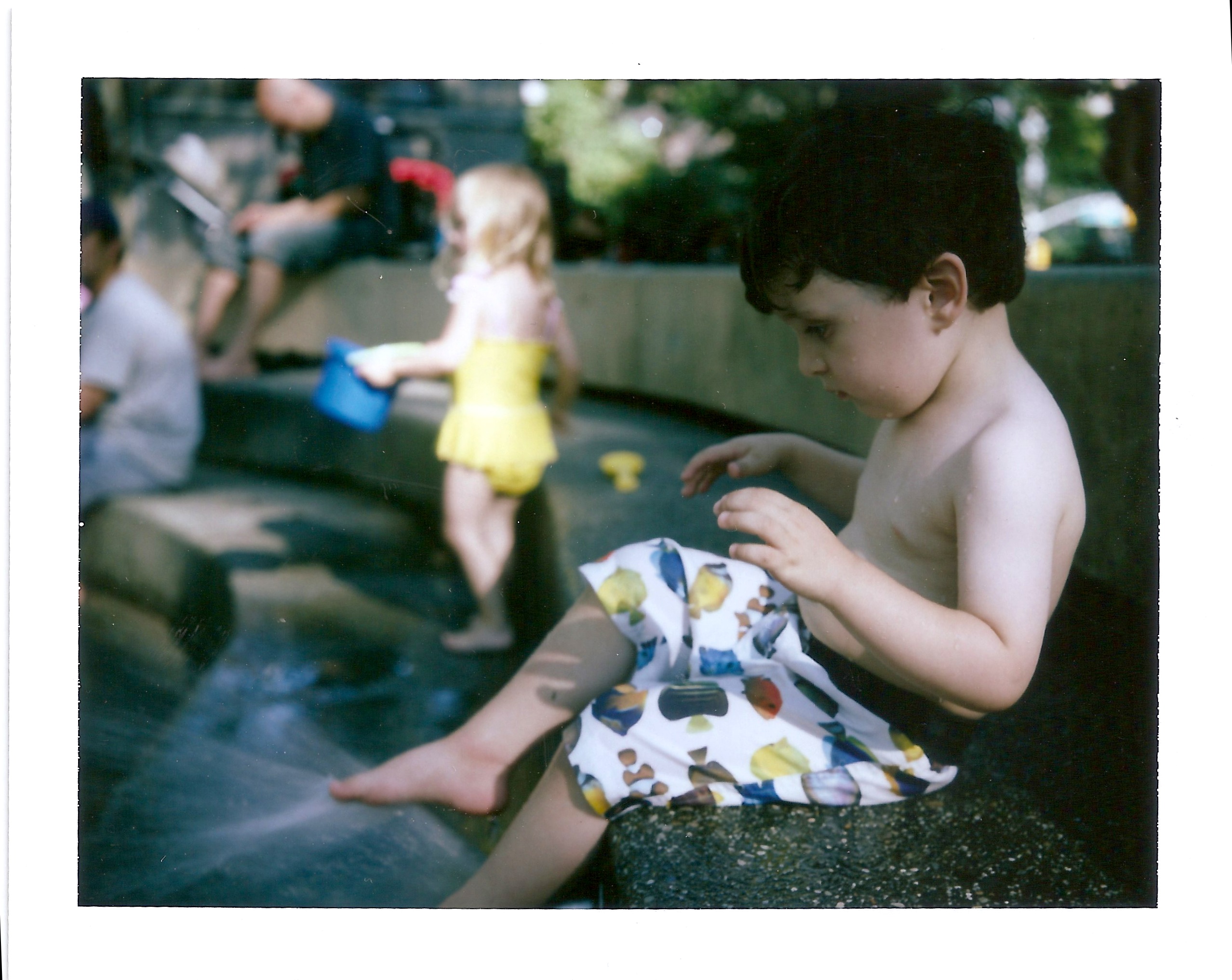
July 4, 2012. (Click for full size.)
BUY THE BOOK

Available in many bookstores, online and off-. Click the photo to order from my local, the Strand Book Store.
BUY THE OTHER BOOK

WATCH THE TRAILER

On Vimeo: click the image to view.
